
Wildlife Journal Junior New Hampshire Public Television Knowledge Network

  Main      Wild Files      N.H. Animals      Animals A-Z      Episodes     KN Home      NHPTV Home

Anhinga - Anhinga anhinga

series details
 Phylum: Chordata
 Class: Aves
 Order: Pelecaniformes
 Family: Anhingidae
 Genus: Anhinga
  Description
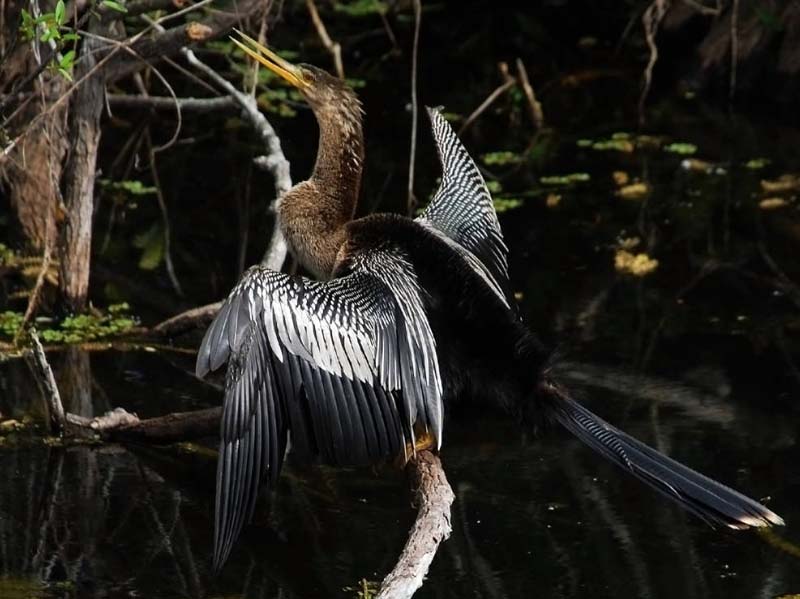
AnhingaThe anhinga is a large bird that is about three feet in length. It has a a long, S-shaped neck and a long pointed bill. It has large wings with silver-white feathers on the top side. The male has grayish-black feathers with a greenish shine to them. The female has a tan head, neck, and chest and a black stomach. Both the male and the female have long, fan-shaped tail feathers. When the anhinga is in its breeding plumage it has a blue ring around its eyes.

anhinga The anhinga has poorly developed oil glands and its feathers aren't as waterproof as the feathers of other water birds. It perches in a tree with its wings open to dry its feathers and warm its body.
  Range
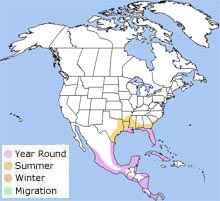
The anhinga breeds off the Gulf Coast and the Atlantic Coast from North Carolina to Texas and in the Mississippi Valley north to Kentucky and Missouri. It winters along the Gulf Coast north to North Carolina.
  Habitat
The anhinga is found in freshwater ponds, lakes, rivers and swamps where there is thick vegetation and tall trees.

  Diet
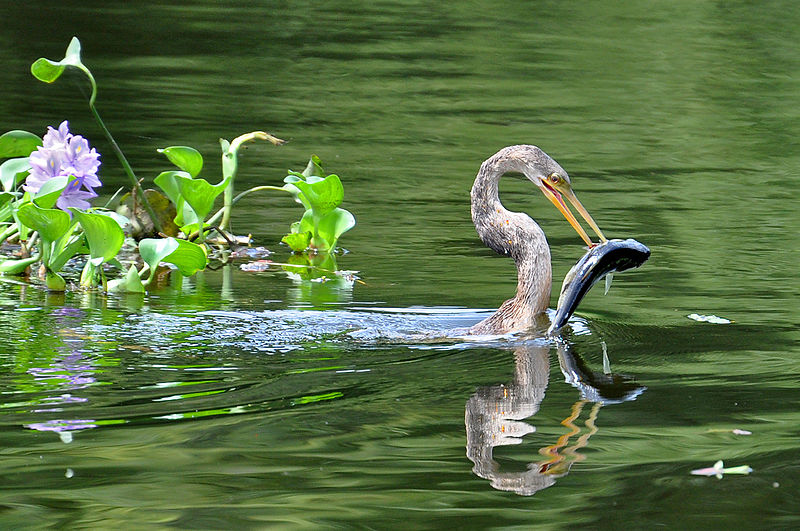
anhingaUsing its sharp bill, the anhinga spears fish, flips them in the air, and swallows them head-first! Sometimes, the anhinga spears a fish so hard that it has to return to shore with the fish still stuck on its bill. The anhinga bangs the fish against a rock to get it off its bill!
  Life Cycle
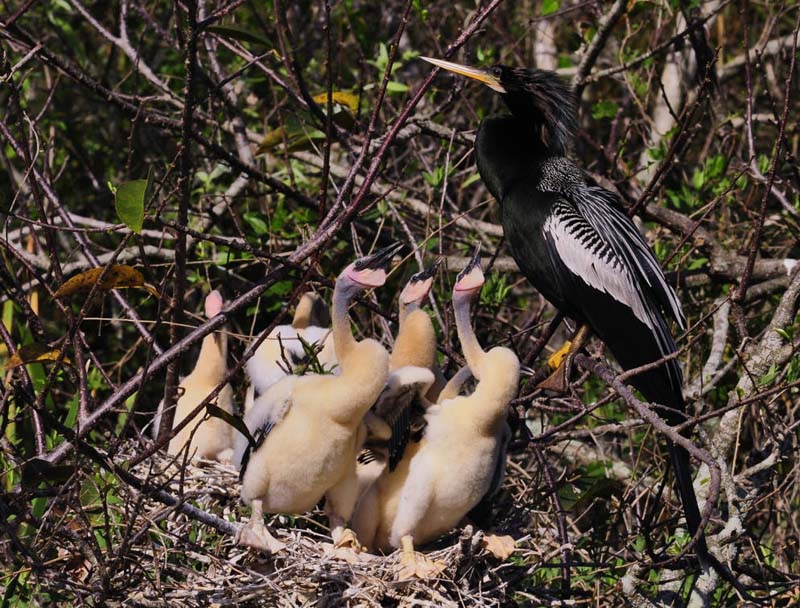
anhingaThe male anhinga courts the female by flying and gliding overhead. The male chooses a nesting site. Once a pair has formed, the male gathers sticks, leaves, and twigs for the nest. The female uses the materials the male gathers to build a platform nest in a tree. The nest is built four to twenty feet above the ground or water. The female lays three to five light blue eggs and both parents incubate the eggs for about a month. The chicks are blind and helpless when they hatch. Both the male and female feed them regurgitated food. The chicks fledge when they are six weeks old, but they stay with their parents for a few more weeks. Male and female pairs may mate for more than one year and often use the same nesting site.
  Behavior
The anhinga is also known as the snakebird. When it swims, its body is submerged under the water. It stretches its head and neck flat out on the surface of the water and its head and neck look like a snake gliding through the water!

MESY = Math + ENGINEERING + SCIENCE + YOU!
Privacy | Pressroom

New Hampshire Public Television
268 Mast Road, Durham, NH 03824. 603-868-1100 Fax 603-868-7552
Contact NHPTV
©2009 All rights reserved