

Black-billed Cuckoo - Coccyzus erythropthalmus |
||||||||||
Description
Range |
HabitatThe black-billed cuckoo is found in thickets, orchards, groves of trees, and marshes, and forest edges. DietCaterpillars make up a large part of the black-billed cuckoo's diet. It also eats other large insects, bird eggs, berries, fruits, and seeds. Life CycleThe female lays 2-4 eggs in a messily arranged cup of twigs and grasses that is placed low in a tree or bush. The eggs are incubated by both parents for 10-13 days and the chicks fledge in 7-9 days. BehaviorThe black-billed cuckoo is often heard and not seen! It stays hidden in dense vegetation. Its call is a "coo-coo-coo-coo" sound, usually repeated a few times. |
|||||||||
Audio Credit: xeno-canto.org Andrew Spencer  |
||||||||||
 Least Concern
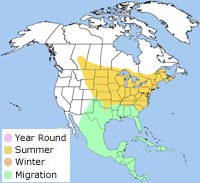 The black-billed cuckoo breeds
from Alberta, Canada east to
Nova Scotia, Canada and south through the United States. It winters in South America.
The black-billed cuckoo breeds
from Alberta, Canada east to
Nova Scotia, Canada and south through the United States. It winters in South America.