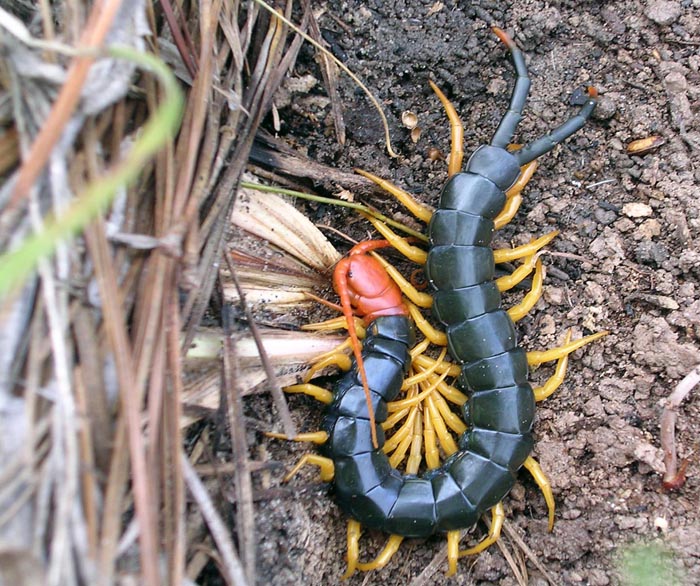
 Centipedes have long, flattened, worm-like, segmented bodies. They can have 12-100 body segments. They have long, jointed antennae on their heads. The next segment of their bodies has a pair of modified legs. These legs are not used for walking, they have sharp poisonous claws on them that the centipede uses to capture and
paralyze
its prey. Each of the remaining segments of their bodies has a pair of jointed walking legs. In many species, the walking legs end in a sharp claw. Centipedes have long, flattened, worm-like, segmented bodies. They can have 12-100 body segments. They have long, jointed antennae on their heads. The next segment of their bodies has a pair of modified legs. These legs are not used for walking, they have sharp poisonous claws on them that the centipede uses to capture and
paralyze
its prey. Each of the remaining segments of their bodies has a pair of jointed walking legs. In many species, the walking legs end in a sharp claw.
Centipedes are nocturnal and spend the day in moist, dark places like under leaf litter, rotting logs, bark, or rocks. The largest centipede in the world is the Scolopendra gigantca. It is a foot in length and lives in South America.
Most centipedes are carnivores and eat insects. There are over
3,000 species of centipedes found throughout the world.
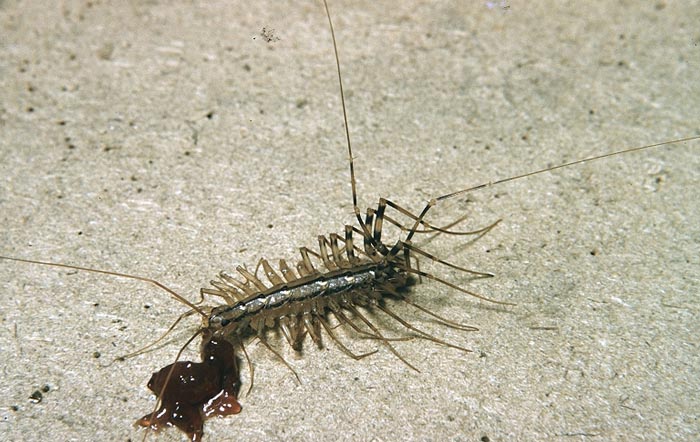
 One species, the house centipede, is found in damp places in houses. It is about 1.5 inches in length and eats small insects like cockroaches, flies, and moths. It has long, feathery legs and very long antennae. The house centipede is native to Mexico, but is now found throughout the United States. One species, the house centipede, is found in damp places in houses. It is about 1.5 inches in length and eats small insects like cockroaches, flies, and moths. It has long, feathery legs and very long antennae. The house centipede is native to Mexico, but is now found throughout the United States. |