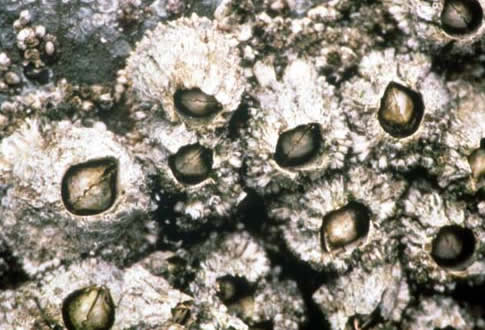

Cirripedia - Barnacles |
|
||
The cyprid does not feed. It attaches itself to a rock or other solid surface using special cement glands in its antennae. Some species even attach themselves to whales! The cyprid has a jointed exoskeleton and 12 feathery appendages called cirri. Once the cyprid has attached itself to a hard surface, it molts and turns its body so that its cirri is face up. A hard, cone-shaped wall of five or six fixed plates forms around the cyprid. At the opening of the wall are four moveable plates that allow the barnacle to stick out its cirri and sweep them through the water to filter out food. |
|||