
Wildlife Journal Junior New Hampshire Public Television Knowledge Network

  Main      Wild Files      N.H. Animals      Animals A-Z      Episodes     KN Home      NHPTV Home

Eurasian Wigeon - Anas penelope

eurasianwigeon
series details
 Phylum: Chordata
 Class: Aves
 Order: Anseriformes
 Family: Anatidae
 Genus: Anas
  Description
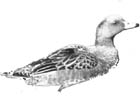
eurasianwigeon The Eurasian wigeon is a dabbling duck that is 17-20 inches in length with a wingspan of 32 inches. The male has rusty red head with a buff-colored crown, a pinkish breast, and a gray body. The female is a dull, mottled grayish-brown. The male and the female have a white shoulder patch and stubby grayish-blue bills with a black tip.
  Range
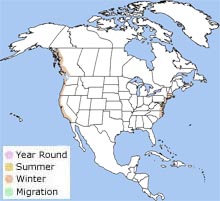
The Eurasian wigeon breeds in Eurasia and Northern Africa. In the winter, it is sometimes found on the Atlantic and Pacific coasts.
  Habitat
The Eurasian wigeon is found on marshes, ponds, lakes, bays, and fields.
  Diet
eurasianwigeon The Eurasian wigeon skims seeds and other plant matter like stems, roots, and leaves from the water's surface. It also grazes for food on land. It sometimes waits for diving ducks to bring plants up to the surface of the water and then snatches away their food!
  Life Cycle

The female lays 7 or 8 eggs in a down and grass filled shallow depression in the ground. The nest is usually well hidden by grass and is near the water. The female incubates the eggs for 24-25 days. The ducklings leave the nest and head to the water shortly after they hatch. They can feed themselves immediately, but the female stays with them until they fledge at 44-45 days old.

  Behavior
eurasian wigeonThe Eurasian Wigeon does not breed in North America, but it is found here in the winter. It is usually found with flocks of American wigeons.

Privacy | Pressroom

New Hampshire Public Television
268 Mast Road, Durham, NH 03824. 603-868-1100 Fax 603-868-7552
Contact NHPTV
©2008 All rights reserved