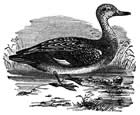
Description 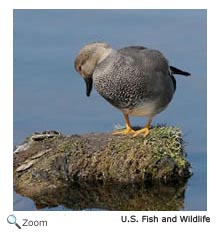 The gadwall is a dabbling duck that is 18-21 in length with a wingspan of 35 inches. The male is gray on his back, chest, and sides and has a brown head and a cinnamon patch on his forewing. The female is a mottled sandy-brown. Both the male and female have a white belly, a grayish-black bill, a black rump, and a white patch on the hind edge of their wings.
The female's bill is edged in orange. The gadwall is a dabbling duck that is 18-21 in length with a wingspan of 35 inches. The male is gray on his back, chest, and sides and has a brown head and a cinnamon patch on his forewing. The female is a mottled sandy-brown. Both the male and female have a white belly, a grayish-black bill, a black rump, and a white patch on the hind edge of their wings.
The female's bill is edged in orange.
Range
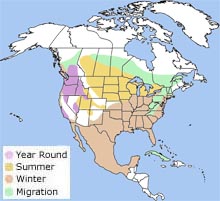 The gadwall is found from the Atlantic Coast of Canada west to Alaska and south to the Mexico. It winters across much of the United States south to Mexico. The gadwall is also found in Iceland, Europe, and Asia. The gadwall is found from the Atlantic Coast of Canada west to Alaska and south to the Mexico. It winters across much of the United States south to Mexico. The gadwall is also found in Iceland, Europe, and Asia.
Habitat 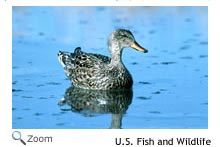 The gadwall
is found in freshwater marshes, prairie potholes, ponds, and small lakes with lots of vegetation. They can occasionally be found in saltwater marshes. The gadwall
is found in freshwater marshes, prairie potholes, ponds, and small lakes with lots of vegetation. They can occasionally be found in saltwater marshes.
| |
Diet 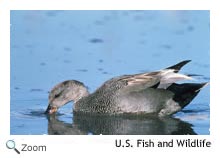 The gadwall probes on the surface and just under the surface of the water for
aquatic vegetation, aquatic invertebrates, and seeds. Although they eat seeds and invertebrates, most of their diet is made up of aquatic vegetation like milfoil. Gawalls are often found with American Coots and diving ducks. They wait for the coots and diving ducks to dive for food and then they snatch up whatever food floats up to the surface of the water. The gadwall probes on the surface and just under the surface of the water for
aquatic vegetation, aquatic invertebrates, and seeds. Although they eat seeds and invertebrates, most of their diet is made up of aquatic vegetation like milfoil. Gawalls are often found with American Coots and diving ducks. They wait for the coots and diving ducks to dive for food and then they snatch up whatever food floats up to the surface of the water.
Life Cycle 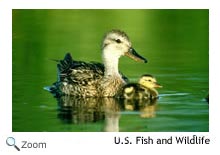 The male courts the female with a series of display behaviors. He throws his head back and raises his tail feathers. He also rears up out of the water and sinks back down while calling out to the female. Both the male and female bob their heads up and down and touch bills together during courtship. The male courts the female with a series of display behaviors. He throws his head back and raises his tail feathers. He also rears up out of the water and sinks back down while calling out to the female. Both the male and female bob their heads up and down and touch bills together during courtship.
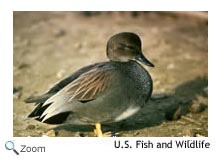 The female chooses a nesting site near the water and scrapes a depression in the ground and lines it with leaves, grass, twigs, and down from her chest. While the female builds a nest, the male stands guard. The female lays 8-11 eggs at a rate of one egg per day. The male leaves the female once she begins to incubate the eggs. The eggs hatch in 25-26 days. The ducklings are precocial and can feed themselves shortly after hatching. The ducklings fledge when they are about 10 weeks old. The female chooses a nesting site near the water and scrapes a depression in the ground and lines it with leaves, grass, twigs, and down from her chest. While the female builds a nest, the male stands guard. The female lays 8-11 eggs at a rate of one egg per day. The male leaves the female once she begins to incubate the eggs. The eggs hatch in 25-26 days. The ducklings are precocial and can feed themselves shortly after hatching. The ducklings fledge when they are about 10 weeks old.
Behavior
The gadwall is a short distance migrator. In some parts of its range, it may not migrate at all. |