Description
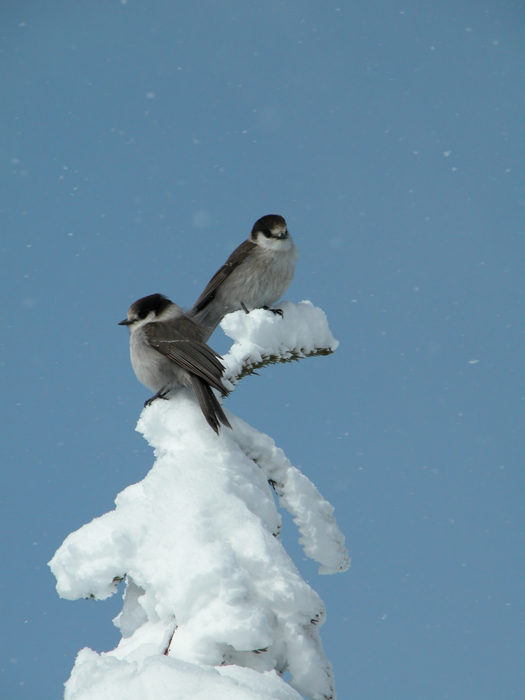
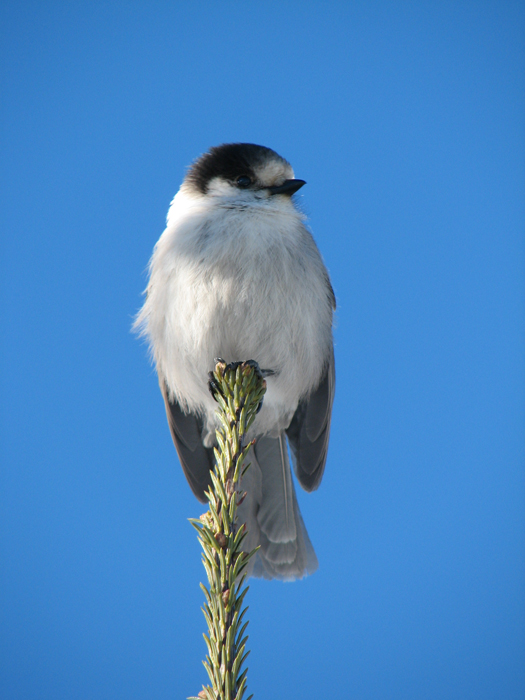
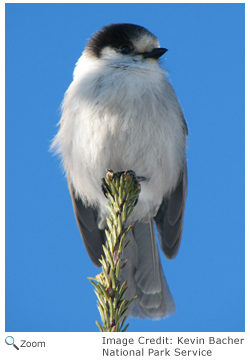
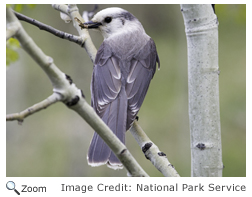 The Canada jay, also known as the gray jay, is about 10 inches in length. It is gray on top and grayish-white on its undersides. It has a white forehead and throat. It has a darker gray cap and nape and a short, dark bill. The Canada jay, also known as the gray jay, is about 10 inches in length. It is gray on top and grayish-white on its undersides. It has a white forehead and throat. It has a darker gray cap and nape and a short, dark bill.
Range
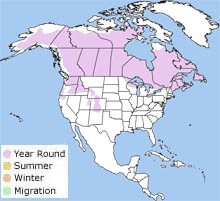 The Canada jay is found from Alaska east to Labrador, and south to northern California, New Mexico, northern New York, and northern New England. The Canada jay is found in northern New Hampshire. The Canada jay is found from Alaska east to Labrador, and south to northern California, New Mexico, northern New York, and northern New England. The Canada jay is found in northern New Hampshire.
HabitatThe Canada jay is found in coniferous and coniferous-deciduous forests. It is most frequently found in spruce and fir forests. It is very rarely seen outside of its forest environment.
Diet 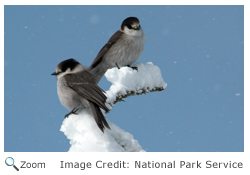 The Canada jay eats fruits, seeds, and insects. In winter, a large part of its diet is made up of conifer seeds. It uses its saliva to roll seeds together into balls; it then stores the seed balls to eat later! The Canada jay eats fruits, seeds, and insects. In winter, a large part of its diet is made up of conifer seeds. It uses its saliva to roll seeds together into balls; it then stores the seed balls to eat later!
|
|
Life Cycle
 The Canada jay mates in the spring. The male chooses a nest site, usually in a conifer tree like the spruce or fir, and then he begins building the nest. The bowl-shaped nest is made of twigs, grass, lichen, moss, and bark that are fastened together with spider webs and insect cocoons. The nest is lined with grass, moss, fur, and feathers. The female helps build the nest. It can tak up to three weeks for the pair to complete the nest. The Canada jay mates in the spring. The male chooses a nest site, usually in a conifer tree like the spruce or fir, and then he begins building the nest. The bowl-shaped nest is made of twigs, grass, lichen, moss, and bark that are fastened together with spider webs and insect cocoons. The nest is lined with grass, moss, fur, and feathers. The female helps build the nest. It can tak up to three weeks for the pair to complete the nest.
The female Canada jay lays 2-5 pale green to gray-green speckled eggs and incubates them for 16-18 days. Both parents care for the chicks. The chicks fledge when they are about 15 days old.
Behavior 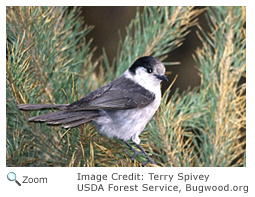 The Canada jay is also known as the "camp robber." It is very tame and it often enters camps to take food. The Canada jay is also known as the "camp robber." It is very tame and it often enters camps to take food.
The Canada jay makes a series of whistling sounds of "wheeoo" or "wheee-ah." It also has a harsher alarm call of "kren kren kren." Its alarm call is a screeching "jaaayy."
|