Description
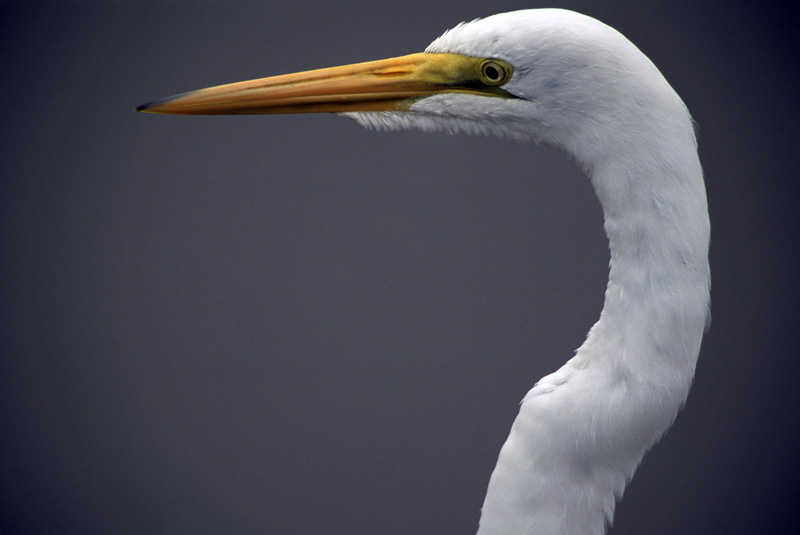
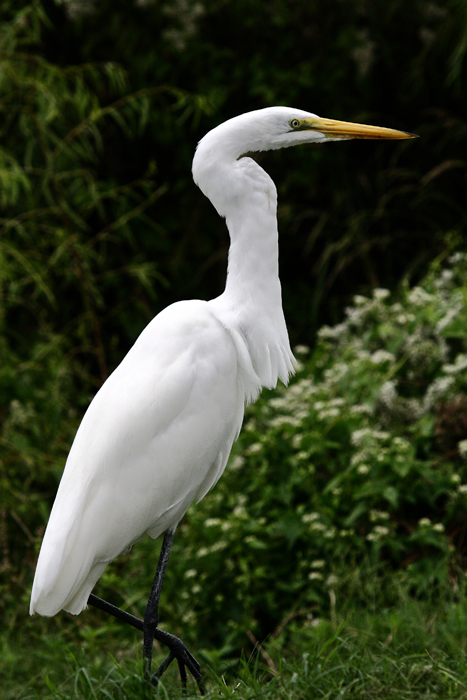
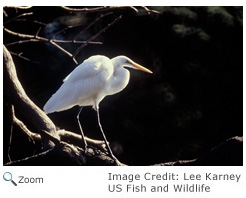
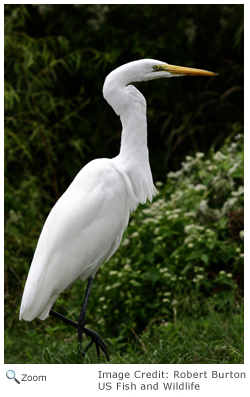 The great egret is a little over three feet tall with a wingspan of almost five feet. Its feathers are entirely white. It has a long, sharp yellow bill and long, gray to black legs with non-webbed feet and very long toes. The great egret is a little over three feet tall with a wingspan of almost five feet. Its feathers are entirely white. It has a long, sharp yellow bill and long, gray to black legs with non-webbed feet and very long toes.
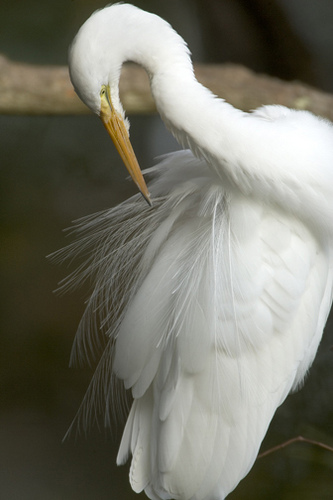
When the great egret is in breeding plumage, it has long lacy and delicate plumes on its back that curl over its tail. Males and females look alike, but males are a little larger.
The great egret is also known as the American Egret, the Common Egret, the Large Egret, the White Egret, and the Great White Egret.
Range 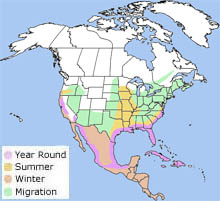 The great egret's breeding range on the Pacific Coast stretches from Oregon to western Mexico. In the central United States, the great egret is found from Minnesota south to the Mississippi Valley and along the Gulf coast. The great egret's breeding range on the Pacific Coast stretches from Oregon to western Mexico. In the central United States, the great egret is found from Minnesota south to the Mississippi Valley and along the Gulf coast.
On the Atlantic coast, it is found from southern New England to Florida. On the Pacific coast, the great egret winters from Oregon to Mexico. On the Atlantic coast, it winters along the coast from New Jersey south to Florida and along the Gulf coast. The great egret is also found in Central and South America.
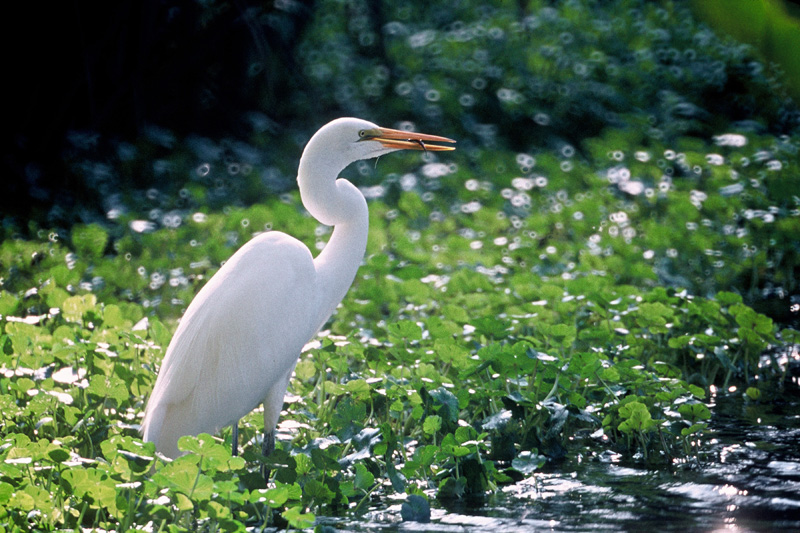
Habitat 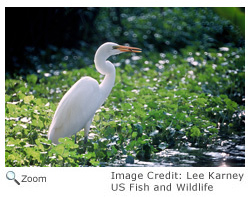 The great egret lives along salt and freshwater marshes, marshy ponds, and tidal flats. The great egret lives along salt and freshwater marshes, marshy ponds, and tidal flats. |
|
Diet 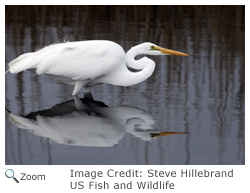 The great egret feeds alone in shallow water. It stalks prey like frogs, crayfish, snakes, snails, and fish. When it spots its prey, it pulls its head and long neck back and then quickly stabs at the prey. On land, it sometimes stalks small mammals like moles and mice. The great egret usually feeds in the early morning and evening hours. The great egret feeds alone in shallow water. It stalks prey like frogs, crayfish, snakes, snails, and fish. When it spots its prey, it pulls its head and long neck back and then quickly stabs at the prey. On land, it sometimes stalks small mammals like moles and mice. The great egret usually feeds in the early morning and evening hours.
Life Cycle
 The male great egret chooses the nesting site and builds a nest platform of sticks and twigs in a tree or bush before he selects a mate. Occasionally, the great egret builds its nest on dry ground near a marsh. The male great egret chooses the nesting site and builds a nest platform of sticks and twigs in a tree or bush before he selects a mate. Occasionally, the great egret builds its nest on dry ground near a marsh.
The female great egret lays 3-5 pale green-blue eggs. The eggs take about three to four weeks to incubate. Both parents incubate the eggs and feed the chicks. The chicks fledge in about six weeks. If the nest is on the ground, the chicks walk around the nest before they fledge. Both the male and female aggressively defend the nesting territory. Great egrets nest in colonies, often with herons and ibis.
Behavior 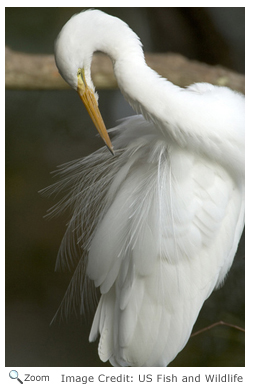 In the early 20th century, the long feathers of the great egret were used on ladies hats and the great egret was almost hunted into extinction. In the early 20th century, the long feathers of the great egret were used on ladies hats and the great egret was almost hunted into extinction.
Millions of North American birds were killed for their feathers in the late 19th and early 20th century. Hunters would kill birds and take their feathers and often leave young chicks alone to fend for themselves. Entire populations of terns, herons, and egrets were destroyed all along the Atlantic Coast.
|