Herpestidae - mongooses
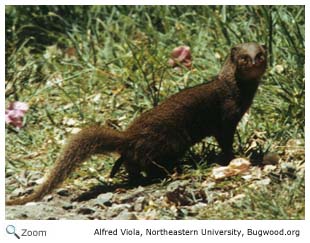 There are 34 species in this family. They are native to Africa and Asia, but they have been introduced all over the world. Mongooses have long bodies; small heads; pointed snouts; short, rounded ears; and long tails. Most species are gray or brown. There are 34 species in this family. They are native to Africa and Asia, but they have been introduced all over the world. Mongooses have long bodies; small heads; pointed snouts; short, rounded ears; and long tails. Most species are gray or brown.
Most species in this family eat small mammals, birds, reptiles, eggs, and insects. They strike their prey quickly and are well-known for their ability to kill poisonous snakes without getting bitten.
The species in this family are found in a wide variety of habitats from forests to deserts. Some species live in colonies, other species are more solitary. Some species in this family are semi-aquatic and other species are at home in trees.
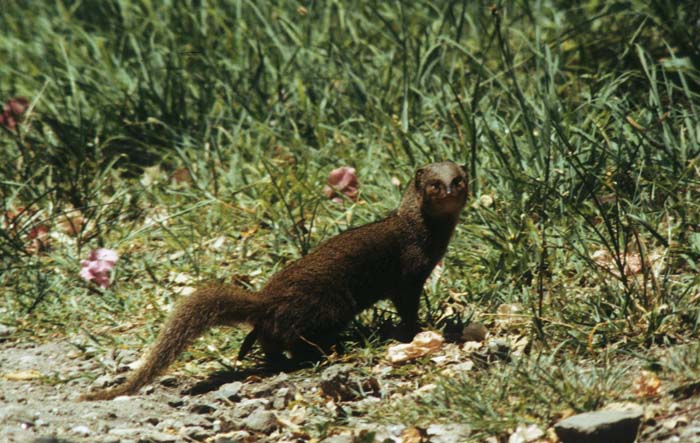
The Indian mongoose was introduced in Hawaii in 1883 in an attempt to kill the rats that were eating the sugar cane crops. Unfortunately, the Indian mongoose hunts during the day and the rats come out at night! Today, the Indian mongoose preys on native Hawaiian animals, especially birds.
World Status Key
 Least Concern Least Concern  Near Threatened Near Threatened  Vulnerable Vulnerable  Endangered Endangered  Critically Endangered Critically Endangered  Extinct in Wild Extinct in Wild  Extinct Extinct
Status taken from ICUN Redlist. If no status is listed, there is not enough data to establish status, or there is no status data for the species.
US Status Key
 Threatened in US Threatened in US  Threatened in NH Threatened in NH  Endangered in US Endangered in US  Endangered in NH Endangered in NH  Introduced Introduced
Status taken from US Fish and Wildlife and NH Fish and Game
New Hampshire Species |
|
North/Central American Species |
| None |
|
Indian Mongoose - Herpestes javanicus |
Additional Information Resource Key
 Profile Profile  Photos Photos  Video Video  Audio Audio
Mongoose
Mongoose are known to break open bird eggs by throwing them at a solid object.
Source: National Geographic Intended Audience: General Reading Level: Middle School
Mongoose
The mongoose uses its sharp claws to dig burrows.
Source: Enchanted Learning Intended Audience: Students Reading Level: Elementary School Banded Mongoose - Mungos mungo 
The banded mongoose is found in Angola, Botswana, Burkina Faso, Burundi, Cameroon, Central African Republic, Chad, Congo, Côte d'Ivoire, Eritrea, Ethiopia, Gabon, Gambia, Guinea, Guinea-Bissau, Kenya, Malawi, Mali, Mozambique, Namibia, Nigeria, Rwanda, Senegal, Somalia, South Africa, Sudan, Swaziland, Tanzania, Uganda, Zambia, and Zimbabwe.
Source: Arkive Intended Audience: General Reading Level: Middle School
Banded Mongoose - Mungos mungo
The banded mongoose is 12 to 16 inches long and has an eight-inch tail.
Source: National Zoo Intended Audience: General Reading Level: Middle School Common Dwarf Mongoose - Helogale parvula
The common dwarf mongoose is found in Angola, Botswana, Congo, Ethiopia, Gambia, Kenya, Malawi, Mozambique, Namibia, Somalia, South Africa, Sudan, Swaziland, Tanzania, Uganda, and Zambia.
Source: Arkive Intended Audience: General Reading Level: Middle School
Common Dwarf Mongoose - Helogale parvula
The common dwarf mongoose is the smallest species of mongoose found in Africa.
Source: African Wildlife Foundation Intended Audience: General Reading Level: Middle School
Common Dwarf Mongoose - Helogale parvula
Dwarf mongooses live in groups of 12 to 15 individuals.
Source: Oregon Zoo Intended Audience: General Reading Level: Middle School Egyptian Mongoose - Herpestes ichneumon 
The Egyptian mongoose is found in Angola, Benin, Botswana, Burkina Faso, Burundi, Cameroon, Central African Republic, Chad, Congo, Côte d'Ivoire, Egypt, Eritrea, Ethiopia, Gabon, Gambia, Ghana, Guinea, Guinea-Bissau, Israel, Jordan, Kenya, Lebanon, Liberia, Libya, Malawi, Mali, Mauritania, Mozambique, Namibia, Niger, Nigeria, Rwanda, Senegal, Sierra Leone, Somalia, South Africa, Sudan, Syria, Tanzania, Togo, Turkey, Uganda, Western Sahara, Zambia, and Zimbabwe.
Source: Arkive Intended Audience: General Reading Level: Middle School
Indian Brown Mongoose - Herpestes fuscus
The Indian brown mongoose is found in India, and Sri Lanka.
Source: Arkive Intended Audience: General Reading Level: Middle School
Indian Gray Mongoose - Herpestes edwardsii
The Indian gray mongoose is found in Afghanistan, Bahrain, Bhutan, India, Indonesia, Iran, Kuwait, Malaysia, Mauritius , Nepal, Pakistan, Saudi Arabia, and Sri Lanka.
Source: Arkive Intended Audience: General Reading Level: Middle School Jackson's Mongoose - Bdeogale jacksoni
Jackson's mongoose is found in Kenya, Tanzania, and Uganda.
Source: Arkive Intended Audience: General Reading Level: Middle School Liberian Mongoose - Liberiictis kuhni
The Liberian mongoose is found in Côte d'Ivoire and Liberia.
Source: Arkive Intended Audience: General Reading Level: Middle School Meerkat - Suricata suricatta
The meerkat is found in Angola, Botswana, Namibia, and South Africa.
Source: Arkive Intended Audience: General Reading Level: Middle School
Meerkat - Suricata suricatta
Meerkats usually live in burrows dug by other animals.
Source: San Diego Zoo Intended Audience: General Reading Level: Middle School
Meerkat - Suricata suricatta
Meerkats are the size of a squirrel.
Source: Enchanted Learning Intended Audience: Students Reading Level: Elementary School
White-tailed Mongoose - Ichneumia albicauda
The white-tailed mongoose is found in Angola, Benin, Botswana, Burkina Faso, Cameroon, Central African Republic, Chad, Congo, Côte d'Ivoire, Djibouti, Egypt, Eritrea, Ethiopia, Gambia, Ghana, Guinea, Guinea-Bissau, Kenya, Malawi, Mali, Mozambique, Namibia, Niger, Nigeria, Oman, Saudi Arabia, Senegal, Sierra Leone, Somalia, South Africa, Sudan, Swaziland, Uganda, Yemen, Zambia, and Zimbabwe.
Source: Arkive Intended Audience: General Reading Level: Middle School
|

 Australia/Oceania
  Europe
  North/Central America
  South America
  NH Species