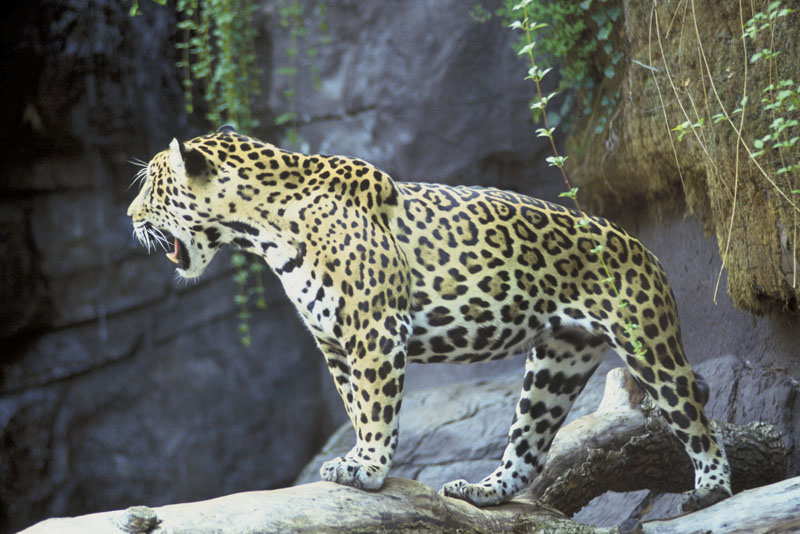
Description
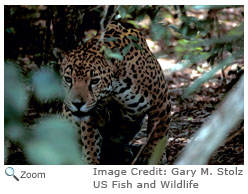
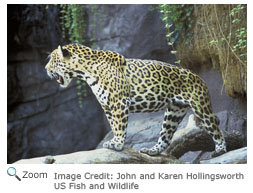
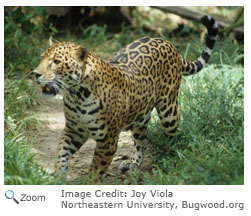 The jaguar is the largest cat in North America and the third largest cat in the world. It stands about 3 feet tall from shoulders to feet, 6½ to 7½ feet long from nose to tail. It weighs between 100 and 250 pounds. It has a stocky body and a big head. Its coat is golden-brown with clusters of black spots that look like rosettes. The jaguar is the largest cat in North America and the third largest cat in the world. It stands about 3 feet tall from shoulders to feet, 6½ to 7½ feet long from nose to tail. It weighs between 100 and 250 pounds. It has a stocky body and a big head. Its coat is golden-brown with clusters of black spots that look like rosettes.
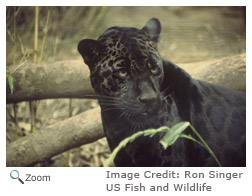 The spot pattern is a small group of spots circled by a larger group of spots. It has single spots on its head, legs, and tail. It has white fur on its undersides, on its chest, and under its nose. Sometimes a jaguar is completely black. Black jaguars still have spots; they are just very difficult to see. The spot pattern is a small group of spots circled by a larger group of spots. It has single spots on its head, legs, and tail. It has white fur on its undersides, on its chest, and under its nose. Sometimes a jaguar is completely black. Black jaguars still have spots; they are just very difficult to see.
Range
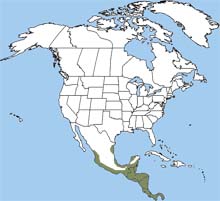 The jaguar's range stretches from Mexico to Patagonia. Although the jaguar has been sighted in Texas, New Mexico, and Arizona, it is extremely rare in the United States and is a federal endangered species. The jaguar's range stretches from Mexico to Patagonia. Although the jaguar has been sighted in Texas, New Mexico, and Arizona, it is extremely rare in the United States and is a federal endangered species.
Habitat
The jaguar makes its home in a variety of habitats including deciduous forests, rainforests, swamps, pampas grasslands, and mountain scrub areas.
|
|
Diet
 The jaguar is a carnivore. It hunts mostly at night. Its prey includes capybara, peccaries, deer, large ground birds, fish, snakes, turtles, and rabbits. It also eats livestock like horses, cows, and sheep. The jaguar hunts mostly on the ground, but it sometimes climbs a tree and pounces on its prey from above. The jaguar has very powerful jaws and sharp teeth and usually kills its prey with one crushing bite to the skull. The jaguar is a carnivore. It hunts mostly at night. Its prey includes capybara, peccaries, deer, large ground birds, fish, snakes, turtles, and rabbits. It also eats livestock like horses, cows, and sheep. The jaguar hunts mostly on the ground, but it sometimes climbs a tree and pounces on its prey from above. The jaguar has very powerful jaws and sharp teeth and usually kills its prey with one crushing bite to the skull.
Life Cycle
Jaguars mate year-round. About 100 days after mating the female has 1-4 kittens. She gives birth in a cave, den, or a thicket. The kittens are born with their eyes closed. At birth, they have fuzzy spotted fur. The kittens begin to hunt when they are six months old. They stay with their mother for about two years. The jaguar has a life span of 15-20 years.
Behavior
 The jaguar is a solitary animal and lives and hunts alone, except during mating season. The male's home range is between 19 to 53 square miles. The female's home range is between 10 to 37 square miles. A male jaguar may share his home range with several females. He aggressively protects his home range from other males to ensure that any females in his territory mate only with him. The jaguar is a solitary animal and lives and hunts alone, except during mating season. The male's home range is between 19 to 53 square miles. The female's home range is between 10 to 37 square miles. A male jaguar may share his home range with several females. He aggressively protects his home range from other males to ensure that any females in his territory mate only with him.
The jaguar, unlike most big cats, loves the water. It often swims, bathes, and plays in streams and pools. It also hunts for fish in the water.
|


 Near Threatened