Description
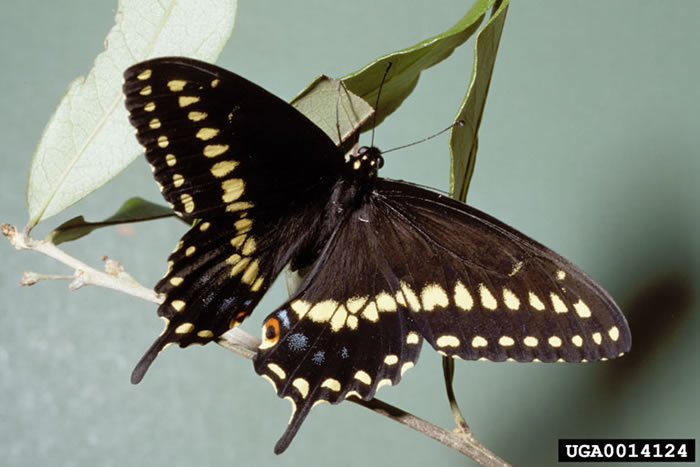
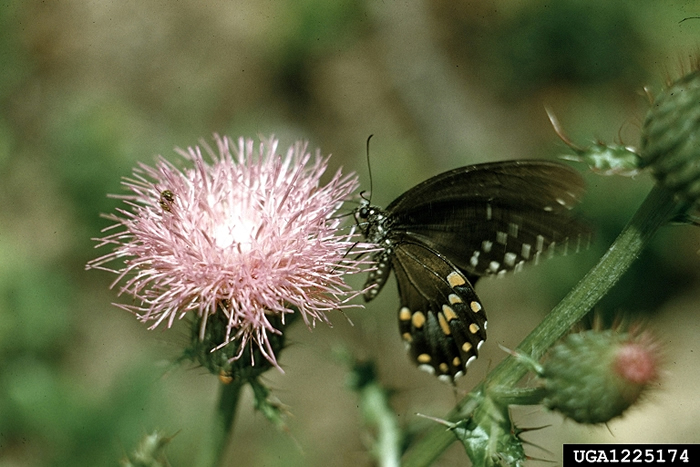
 The black swallowtail has a wingspan of 3-4 inches. The uppersides of its wings are dark blue to black with rows of yellow spots along the edges of its hindwings and forewings. It also has a blue band of spots and reddish orange eyespots on its hindwings. The undersides of its wings are black with two rows of orange spots. The black swallowtail has a wingspan of 3-4 inches. The uppersides of its wings are dark blue to black with rows of yellow spots along the edges of its hindwings and forewings. It also has a blue band of spots and reddish orange eyespots on its hindwings. The undersides of its wings are black with two rows of orange spots.
Range 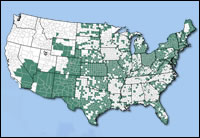 The black swallowtail's range stretches from southern Canada to northern Mexico. It is
found in most of the eastern United States as well as parts of the western United States including California, Nevada, Colorado and New Mexico. The black swallowtail is found throughout New Hampshire. The black swallowtail's range stretches from southern Canada to northern Mexico. It is
found in most of the eastern United States as well as parts of the western United States including California, Nevada, Colorado and New Mexico. The black swallowtail is found throughout New Hampshire.
Habitat
The black swallowtail is found in open areas including fields, parks, and meadows. |
|
|
|
Diet 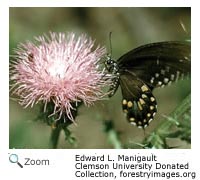 The black swallowtail caterpillar feeds on many different plants in the Apiaceae, or carrot family, including Queen Anne's lace, celery, parsley, carrots, dill, and parsnip. The butterfly eats nectar from a variety of plants including clover, milkweed, thistles, and phlox. The black swallowtail caterpillar feeds on many different plants in the Apiaceae, or carrot family, including Queen Anne's lace, celery, parsley, carrots, dill, and parsnip. The butterfly eats nectar from a variety of plants including clover, milkweed, thistles, and phlox.
Lifecycle
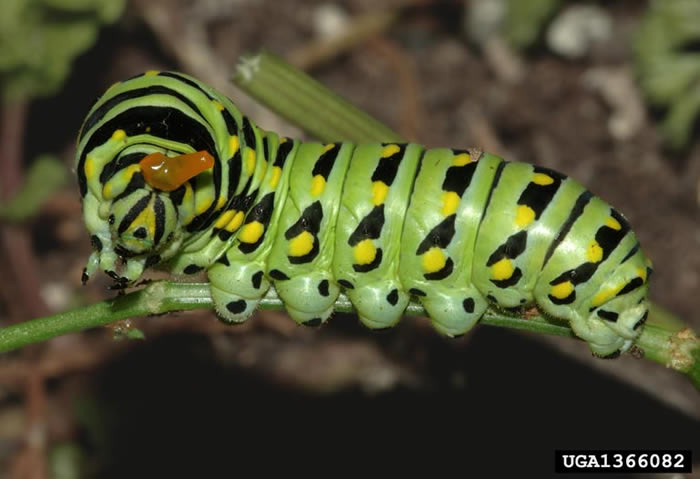
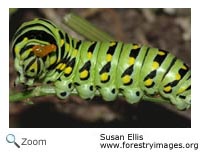 The black swallowtail has two generations a year. The first group of butterflies emerges between late April and early June after having overwintered in the chrysalis. They mate and then the females lay small white eggs on the underside and tops of plant leaves. The eggs hatch in 3-5 days. The caterpillar that emerges is black with a white band around its middle. As it grows, it develops reddish orange spikes on its body. Later, the white band disappears and the caterpillar develops green and black bands with yellow spots. It pupates for 9-11 days, unless it is in the generation that overwinters. The second group of butterflies emerges in the late summer. The second generation mates, and their eggs become the first generation the next spring! The black swallowtail has two generations a year. The first group of butterflies emerges between late April and early June after having overwintered in the chrysalis. They mate and then the females lay small white eggs on the underside and tops of plant leaves. The eggs hatch in 3-5 days. The caterpillar that emerges is black with a white band around its middle. As it grows, it develops reddish orange spikes on its body. Later, the white band disappears and the caterpillar develops green and black bands with yellow spots. It pupates for 9-11 days, unless it is in the generation that overwinters. The second group of butterflies emerges in the late summer. The second generation mates, and their eggs become the first generation the next spring! |