

Ocelot - Leopardus pardalis |
||||||||
Description Range HabitatThe ocelot makes its home in forested areas and in dense chaparral. |
DietThe ocelot eats mice, rabbits, rats, birds, snakes, lizards, fish, and frogs. The ocelot is solitary, but it will sometime hunt with another ocelot. It calls to its hunting partner with meows that sound like a house cat's call. The ocelot hunts most of its prey on the ground, but it sometimes catches a bird in a tree. The ocelot removes all of the fur and feathers from its prey before it eats it. Life CycleThe ocelot mates year-round. About 70 days after mating, the female gives birth to 1-3 young. The female makes a den in the brush. She leaves the kittens at night to hunt for food, but she spends the day with them. The kittens begin hunting with their mother when they are about three months old. The kittens may stay with the mother for up to a year. Behavior
The ocelot does most of its hunting at night. It rests in trees or dense brush during the day. It has a home range of between one and four square miles. The ocelot spends most of its time on the ground, but it is a good swimmer and climber.
|
|||||||

 Least Concern

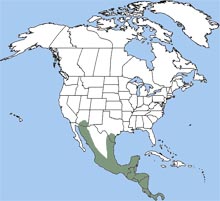 The ocelot is found from Arizona and Texas south to Argentina. It is an endangered species in Arizona and Texas.
It was once found throughout
Texas and east into Arkansas and Louisiana, but due to habitat loss and hunting, the ocelot population in the United States is probably less than 100 individuals in Texas and Arizona.
The ocelot is found from Arizona and Texas south to Argentina. It is an endangered species in Arizona and Texas.
It was once found throughout
Texas and east into Arkansas and Louisiana, but due to habitat loss and hunting, the ocelot population in the United States is probably less than 100 individuals in Texas and Arizona.