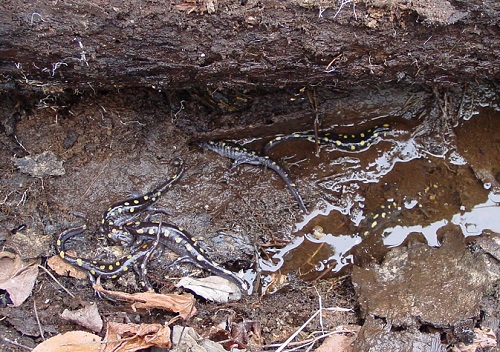

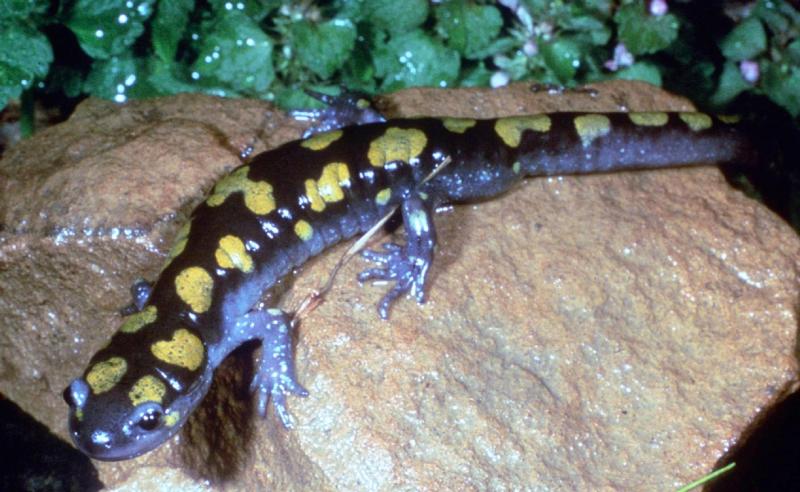
Spotted Salamander - Ambystoma maculatum |
||||||||
Description
Range HabitatThe spotted salamander lives in hardwood forests and hillsides. |
DietThe spotted salamander uses its sticky tongue to catch worms, insects, and snails. Life Cycle The spotted salamander usually moves to breeding ponds at night during the first rain after the winter thaw. Males arrive at the breeding ponds first. The female lays one or more egg masses covered with a jelly-like substance. Each egg mass contains about 100 eggs. The egg masses stick to submerged branches and other objects. The larvae hatch in 1-2 months, depending on the water temperature. Young larvae eat zooplankton and insect larvae and, sometimes, other spotted salamander larvae. The larvae become salamanders in 2-4 months. BehaviorThe spotted salamander spends most of its time underground. It needs areas with soil that is easy to burrow into. Some spotted salamanders can live to be 30 years old! |
|||||||

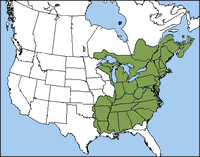 The spotted salamander is found from Ontario, Canada east to Nova Scotia, Canada and south to Georgia and Texas. The spotted salamander is found in New Hampshire.