
Wildlife Journal Junior New Hampshire Public Television Knowledge Network

  Main      Wild Files      N.H. Animals      Animals A-Z      Episodes     KN Home      NHPTV Home

Solitary Sandpiper - Tringa solitaria

Baird's Sandpiper
series details
 Phylum: Chordata
 Class: Aves
 Order: Charadriiformes 
 Family: Scolopacidae 
 Genus:   Tringa

  Description
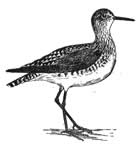
solitary sandpiperThe solitary sandpiper is a medium-sized shorebird 9 inches in length with a 15-17 inch wingspan. It has a pointed bill, long greenish legs, a medium-sized neck, and an olive-green back and wings marked with white spots. It has a barred tail, a gray streaked head, and white circles around its eyes. Males and females look alike, but the female is a little larger.
  Range
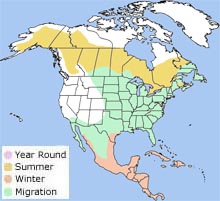
The solitary sandpiper breeds across Alaska and Canada south into northeastern Minnesota. It migrates along the Atlantic Coast and the interior of the United States. It winters from southern Texas south to the Caribbean, Central America, and South America. The solitary sandpiper is truly solitary, it migrates alone, not in flocks.
.
  Habitat
The solitary sandpiper breeds on the tundra and the taiga, especially in areas with spruce trees. During migration, it is found on the banks of wooded streams and ponds, on the of shores of lakes, on mudflats, and in marshes. In the winter, it is found along river banks and in swamps.
  Diet
The solitary sandpiper forages in shallow water and skims food up from the surface of the water. It eats insects, larvae, small fish, tadpoles, frogs, spiders, and worms. It often shakes its foot to stir prey up to the surface of the water. Occasionally, it probes in the water for food and it also forages for food on land.
  Life Cycle
The male selects the nesting site. He chooses the abandoned nest of a songbirds like American robins, rusty blackbirds, eastern kingbirds, gray jays or cedar waxwings. The nest is usually in a conifer tree, sometimes as high as 40 feet above the ground. The female may rearrange the nest after the male selects it. She lays 3-5 eggs. Both parents incubate the eggs for 23-24 days. The chicks are precocial and leap from the nest shortly after hatching.
  Behavior

The solitary sandpiper and the green sandpiper of Eurasia are the only species of sandpipers that nest in trees!

Privacy | Pressroom

New Hampshire Public Television
268 Mast Road, Durham, NH 03824. 603-868-1100 Fax 603-868-7552
Contact NHPTV
©2008 All rights reserved